
Gas Stove Burner Won't Light? Safe Checks and Fixes
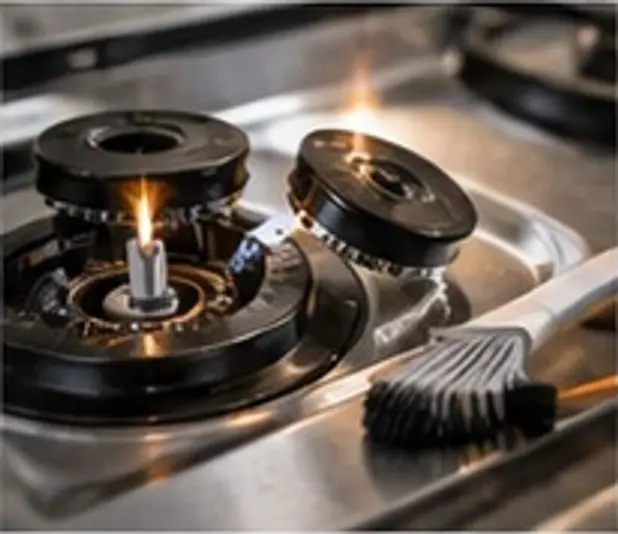
Gas safety first
If you smell gas, do not try to light the burner, use light switches or use your phone inside the home. Leave right away and call your gas utility or 911 from outside.
When there is no gas smell, turn the burner knobs off and let the cooktop cool before checking anything. Unplug the range or turn off its breaker if you are going to remove burner caps or clean around the igniters.
Listen for the click
Turn the knob to light and listen.
- Clicking but no flame: the igniter is sparking, but gas is not reaching it or the spark cannot reach the gas. Look at the cap, the burner ports and moisture.
- No clicking on one burner: that burner's igniter, its wire, or its switch behind the knob may be at fault.
- No clicking on any burner: power is not reaching the spark module. Check the plug, breaker and GFCI, or the module itself may be failing.
- Clicking that will not stop: usually moisture on the igniter or a switch that is stuck on.
Check the burner cap and head
After cleaning, the burner cap is often put back slightly off center. When it does not sit flat on the burner head, gas does not flow out evenly and the igniter may not catch.
Lift the cap off, then set it back on so it sits evenly and does not wobble. On many models the cap and burner head have notches or pins that must line up. If your cooktop has several burner sizes, make sure each cap is on the correct burner.
Dry and clean the igniter and ports
- Moisture. Boil-overs and cleaning water can soak the igniter. Remove the cap and let the burner dry for a few hours, or use a hair dryer on low to speed it up. A burner that clicks constantly after a spill often stops on its own once dry.
- Igniter tip. Grease and food on the small ceramic igniter can block the spark. Wipe it gently with a dry cloth or soft toothbrush. Do not use a wet cloth or harsh cleaner on it.
- Burner ports. The small holes around the burner head can clog with grease. With the burner head removed and cool, clear each port gently with a straightened paper clip or a sewing needle. Avoid toothpicks, which can break off inside.
- Reassemble dry. Make sure the head and cap are completely dry before you put them back and try again.
Read the flame once it lights
When the burner does light, take a look at the flame. A healthy gas flame is mostly blue, even all the way around the burner, and sits close to the ports. A few flickers of orange are usually dust or humidity and are harmless.
- Flame only on part of the burner: some ports are still clogged, or the cap is not sitting flat.
- Large yellow or orange flames: the burner may not be getting the right mix of air and gas. This can leave soot on pans and should be checked by a professional.
- Flame that lifts off the burner or blows out easily: often a gas pressure or burner setup issue that needs a technician.
If the burner lights only after several seconds of clicking, gas may be building up before ignition. Stop using that burner until it has been inspected.
If the whole stove will not light
If no burner lights and the oven also will not heat, check that the range is plugged in and the breaker is on. Gas ranges still need electricity for the igniters. During a power outage, many gas cooktop burners can be lit carefully with a long match, but follow your owner's manual and never do it if you smell gas.
Also check that the gas supply valve behind the range is open. It may have been bumped closed when the stove was moved. Do not disconnect, adjust or tighten gas fittings yourself. A professional should handle any gas line or valve work.
When to call a technician
Call if a burner still will not light after you cleaned, dried and reseated the cap, if one burner never clicks, if clicking continues after the burner is dry, if the flame is yellow, uneven or lifts off the burner, or if you smell gas after lighting. These point to an igniter, switch, spark module or a gas flow problem that needs a professional.
Mr. Fixer provides stove repair for gas ranges and cooktops across Metro Atlanta, including GE, Whirlpool, Samsung, Viking and Wolf. For full-range issues, see our oven and cooktop repair page. Phone us at (678) 866-3669, or reserve a time slot online.
Need it fixed?
Our technicians handle stove & range repair across Metro Atlanta, usually the same day. Diagnostic from $80, credited toward your repair.
Call (678) 866-3669FAQs
Why does my gas burner click but not light?
Usually the burner cap is misaligned, the burner ports are clogged, or the igniter is wet or dirty. Reseat the cap, clear the ports with a paper clip and let everything dry. If it still will not light, have the igniter and gas flow checked.
Why will my stove not stop clicking?
Continuous clicking is commonly caused by moisture on the igniter or under the knob after cleaning or a spill. Let the cooktop dry completely. If it continues, the igniter switch may be stuck and needs replacement.
Can I light my gas stove during a power outage?
On many gas cooktops, burners can be lit carefully with a long match while the power is out. Check your owner's manual first. Ovens with electronic ignition typically will not work during an outage.
More repair guides
How Much Does Stove Repair Cost in Atlanta?
Stove and cooktop repair at Mr. Fixer starts with an $80 diagnostic, credited toward the repair if you go ahead, and repairs on standard gas and elect…
Read the guide →
Refrigerator Not Cooling? Common Causes and What to Check
A refrigerator that stops cooling is most often dealing with dirty condenser coils, a failed evaporator or condenser fan, a defrost problem that has i…
Read the guide →
Samsung Refrigerator Not Cooling: Causes and Fixes
When a Samsung refrigerator stops cooling, the most common cause is ice building up on the evaporator coil behind the freezer's back panel because par…
Read the guide →