
Freezer Not Freezing? Causes, Safe Checks and Fixes
Protect your food first
Keep the door closed while you figure out what is wrong. A full freezer holds its temperature much longer than a half-empty one, and food that still has ice crystals or is at 40°F or below can generally be refrozen safely. Food safety guidance recommends a freezer temperature of 0°F.
Put an appliance thermometer in the middle of the freezer and read it after several hours. That number tells you whether you are dealing with a freezer that is a little warm, which often has a simple cause, or one that is not cooling at all.
Safe checks for any freezer
- Setting. Make sure the control was not turned down during cleaning or loading. On many refrigerators, the freezer and fridge settings are linked, so check both.
- Door gasket. Look for tears, flattened spots or food residue. Close the door on a sheet of paper in several places and pull it out. If it slides out freely, cold air is escaping there.
- Something holding the door open. An overfilled shelf or a box sticking out can keep the door from closing by a fraction of an inch.
- Airflow. In frost-free freezers, cold air comes from vents on the back wall. Keep packages a few inches away from them.
- Condenser coils. With the unit unplugged, vacuum the coils at the bottom front or back.
Garage refrigerators and Georgia heat
Many Atlanta homes keep a second refrigerator in the garage, and garages here can get very hot in summer and cold on winter nights. Most refrigerators are designed to run within a certain range of room temperatures, which your owner's manual lists. Outside that range, they may run constantly without keeping up, or in the cold, shut off for long stretches and let the freezer section warm.
If your garage refrigerator's freezer struggles only in July and August, improve ventilation around it, keep it out of direct sun, and leave several inches of space on all sides. Some models are specifically rated for garage use, which is worth knowing if you replace one.
Frost buildup in the freezer section
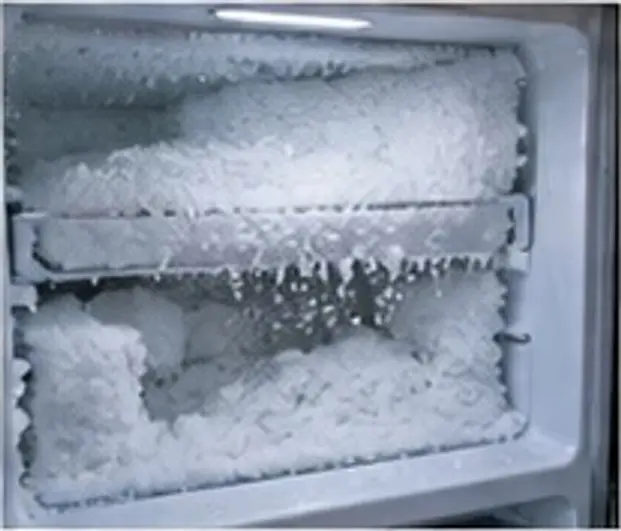
Frost near the door or on packages at the front usually means warm, humid air is getting in. Check the gasket and make sure nothing keeps the door from closing. Do not chip at ice with a knife or screwdriver, since a puncture in the wall can damage the sealed system.
Frost-free freezers should not build up thick frost. If you see heavy frost on the back panel, ice around the vents, or a fan that scrapes, the automatic defrost system has probably failed. That means a heater, a defrost thermostat or sensor, or the control, and it is a repair rather than a cleaning job.
Parts that commonly fail
- Evaporator fan. In frost-free models this fan circulates cold air. If it stops, the coil gets cold but the freezer does not. Open the door and listen; on many models the fan pauses when the door opens, so press the door switch to check.
- Condenser fan. Where present, this fan cools the compressor and coils. A stalled fan leads to overheating and short cycling.
- Start relay and overload. A repeated click from the back every few minutes, with no steady hum after, often means the compressor is trying and failing to start.
- Thermostat or control board. If the control does not call for cooling, nothing runs.
- Compressor or refrigerant leak. Possible, but usually ruled in only after the parts above check out. Sealed-system work requires specialized equipment and regulated refrigerant handling, so it is never a do-it-yourself repair.
When to call a technician
Call if the freezer stays above about 10°F after a day with good airflow and a clean gasket, if a frost-free model is icing up on the back wall, if you hear clicking without the compressor running, or if the compressor runs nonstop and the freezer still will not get cold. Act quickly if food is at risk.
Mr. Fixer provides freezer repair for the freezer section of residential refrigerators throughout Metro Atlanta. When the cause is in the sealed system, we also handle compressor and sealed system repair. Most Atlanta-area freezer calls can be seen the same day. Ring (678) 866-3669, or request a time online around the clock.
Need it fixed?
Our technicians handle refrigerator freezer repair across Metro Atlanta, usually the same day. Diagnostic from $80, credited toward your repair.
Call (678) 866-3669FAQs
What temperature should my freezer be?
Food safety guidance recommends 0°F. Use an appliance thermometer placed in the middle of the freezer to check it, since the dial settings on most freezers are not marked in degrees.
Why is my freezer running but not freezing?
Common causes are a door that is not sealing, blocked vents, dirty condenser coils, a failed evaporator fan, or a defrost problem that has iced over the coil. Less often, the compressor or a refrigerant leak is involved.
Why is there frost on the back wall of my freezer?
In a frost-free refrigerator, heavy frost on the back panel usually means the automatic defrost system has failed: a defrost heater, a defrost thermostat or sensor, or the control. Frost near the door more often points to a gasket that is not sealing.
More repair guides
Refrigerator Not Cooling? Common Causes and What to Check
A refrigerator that stops cooling is most often dealing with dirty condenser coils, a failed evaporator or condenser fan, a defrost problem that has i…
Read the guide →
Samsung Refrigerator Not Cooling: Causes and Fixes
When a Samsung refrigerator stops cooling, the most common cause is ice building up on the evaporator coil behind the freezer's back panel because par…
Read the guide →
Dryer Not Heating? Causes, Safe Checks and Fixes
A dryer that runs but does not heat usually has a blown thermal fuse, a failed heating element (electric) or igniter (gas), a bad thermostat, or a tri…
Read the guide →